Recently I have been trying to grapple with the idea of the “art game”. Namely, how exactly one goes about defining what exactly an art game is. While this may seem like a simple problem to figure out, after all, there are plenty definitions of what an art game is. However, I find that many of these definitions tend to not be particularly satisfying or too vague for my tastes. As an example, allow me to break down the following definition of an art game proposed by John Sharp.
When we think of systems in games, it is usually
in the context of modeling phenomena from the
physical and social world—a game of tennis, in
the case of Pong. But in artgames, the systems are
more likely to model ideas and concepts: the
journey of life, the ethical complicity of the
people involved in carrying out atrocities, the
helplessness of depression. Artgames are usually
highly stylized systems, using abstraction,
allegory, and metaphor to create an idea space
that the player can explore by engaging with the
system through its game mechanics” (Sharp, 51)
From this, we get 3 central ideas of what an art game is. 1) An art game models more abstract ideas and concepts rather than more concrete, physical phenomena, 2) art games tend to have highly stylized aesthetics, and 3) art games use abstraction and metaphor to have the player engage with its ideas through its game mechanics.
These two ideas create an image of classic art games like Braid or Problem Attic. Avant-Garde indie games that have complex, layered stories, unique visual aesthetics, and integrate their central ideas into their game mechanics. However, I do not think that the ideas of the art game outlined above necessarily limit the definition of an art game to these traditional examples. It seems to me that there a large variety of games that, while not at all similar to our traditional idea of an art game, could be defined as an art game.
To illustrate this point, allow me to explain why I believe that one of my favorite games, Donkey Kong Country, could be considered an art game.
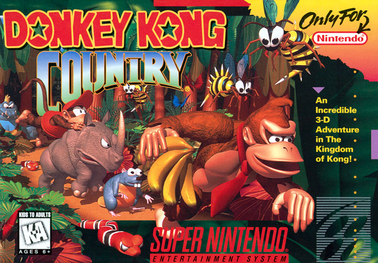
I chose Donkey Kong Country (from this point on abbreviated as DKC) both because it is a game near and dear to my heart and because, on a surface level, it seems nothing like what we traditionally understand as an art game. First of all, the game came out in 1994, nearly a decade and a half before the traditional start of the art game movement. Secondly, the game was published by Nintendo, and as such is almost the opposite of an indie game, which art games tend to be. And thirdly, the game’s plot does not at all seem to have a complex story or any level of abstraction, allegory, or metaphor.
For those unaware of DKC’s story, one day the Kremlings, a group of villainous crocodile creatures, came to DK Isle, Donkey Kong’s home, and stole Donkey Kong’s prized banana horde. Furious at this, Donkey Kong goes on a quest of revenge with his companion Diddy Kong to fight the Kremlings and reclaim his banana horde.
That’s it.
I realize that this surface level of description of the plot does not make this game seem very “artgamey”. However, I would argue that through it’s environmental storytelling, DKC tells a complex story about the harsh effects of colonialism and industrial capitalism on both indigenous populations and the environment. I realize that this is a rather large jump from the banana story, but bear with me.
Simply put, the Kremlings are nothing but cold-blooded capitalist colonizers. They invade DK Isle in an attempt to pillage and exploit its natural resources and destroy its native inhabitants. These two facts are evident in both the existing story of the game, but even more clear in the environmental design of the levels and the design of the Kremlings themselves.
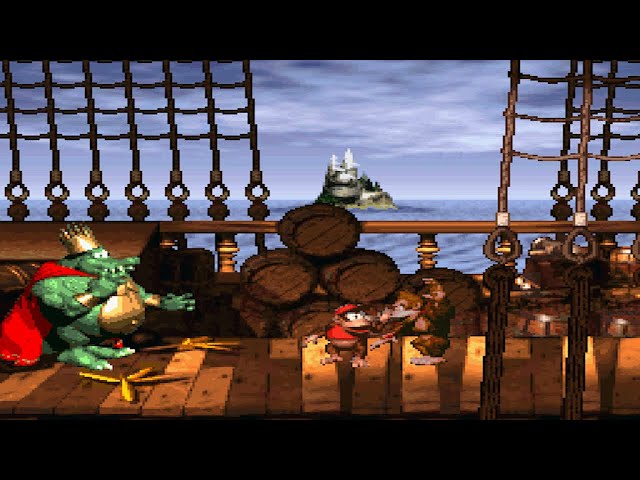
The Kremling’s only stated goal is to steal DK Isle’s local resources, bananas, which puts them in an antagonistic relationship with DK Isle’s indigenous population, the Kongs. This is a rather clear parallel to historical western colonial relationships, where western colonizers invaded islands, stole their natural resources, and enslaved or killed their local population. To give further evidence that DKC’s core story is a representation of colonialism, the designs of the Kremlings clearly reflect their status as representations of western colonialism. The Kremlings arrive to DK Isle via a pirate ship with a European design, some Kremlings (such as Krusha and Klump) wear American military garb, and they are a monarchy, with King K Rool serving as their supreme sovereign.
While this narrative of colonialism may seem straightforward, the narrative of capitalism is much more abstract and, in my opinion, where the more artgamey aspects of DKC arise. This is because the narrative of the Kremlings bringing industrial capitalism to DK Isle is told entirely through DKC’s level design. The largest part this lies in the fifth world, Kremkroc Industries. Kremkroc Industries features all of DKC’s factory levels, which are levels that take place entirely within the aesthetic of a factory. The Kong’s must jump across flaming oil drums, navigate moving conveyor belts, and fight industrially equipped Kremlings. The level design and environment also tells that Kremkroc Industries, and the Kremlings that own it, are a corrupting, polluting force on DK Isle. This is primarily shown through Kremkroc Industries’ water level, Poison Pond, which turns the normally blue water into a radioactive green.
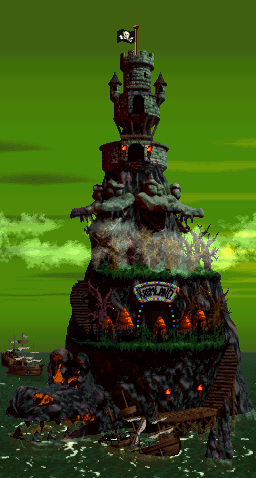
This narrative of Kremlings being Western, industrial polluters is made even stronger in Donkey Kong Country 2: Diddy’s Kong Quest. In this game, we visit the home of the Kremlings, Crocodile Isle, which is shown to completely polluted, filled with factories, and crowned with a giant European style castle. As some additional notes, some of the game’s most iconic set pieces, such as the minecart levels, serve as a way to communicate this story. The existence of the mine carts, and the Kremlings manning them, indicate that they are digging deep into DK Isle to take its resources beyond just bananas.
In this sense, the Kremlings can clearly be read as forces representing colonialism’s plunder of natural resources and attack on indigenous populations, as well as capitalism’s exploitation and pollution of the environment. In this sense, Donkey Kong becomes not just somebody trying to get his bananas back, but rather a guerilla gorilla dead set on reclaiming his homeland from the oppressive claws of the Kremlings.
None of this narrative of colonialism and capitalism is explicit in the game’s narrative, which focuses solely on the Kongs and their quest to reclaim their banana hoard. This is only found through paying careful attention to the level and character design of DKC. As such, I hope that I have convincingly shown that DKC is a game that has a much more complex narrative hidden beneath its surface.
I believe that this narrative I have outlined, along with the way it is communicated to the player, is enough to constitute DKC as an art game. Allow me to more thoroughly break it down by explaining how DKC fits each of the 3 central ideas of an art game.
1. An art game models more abstract ideas and concepts rather than more concrete, physical phenomena
As shown, DKC’s story is about more than the concrete story of reclaiming stolen treasure, and instead features a narrative about the corrupting influence of capitalism on the environment as well as the oppressive force of colonialism. While once could argue that capitalism and colonialism are more akin to physical phenomena since they physically happen in the world, I would argue that tackling the effects of complex ideological and political counts more as tackling an idea. Something more physical would be the game’s presented story, which is a simple story of retaking something stolen.
2. Art games tend to have highly stylized aesthetics
DKC’s visual style is incredibly unique for a Super Nintendo game. In fact, it’s aesthetics, which involve the rendering of 3d models as 2d pixel art, as well as highly realistic environments, were considered cutting edge at the time and remains a style incredibly distinctive to the Donkey Kong Country Series.
3. Art games use abstraction and metaphor to have the player engage with its ideas through its game mechanics.
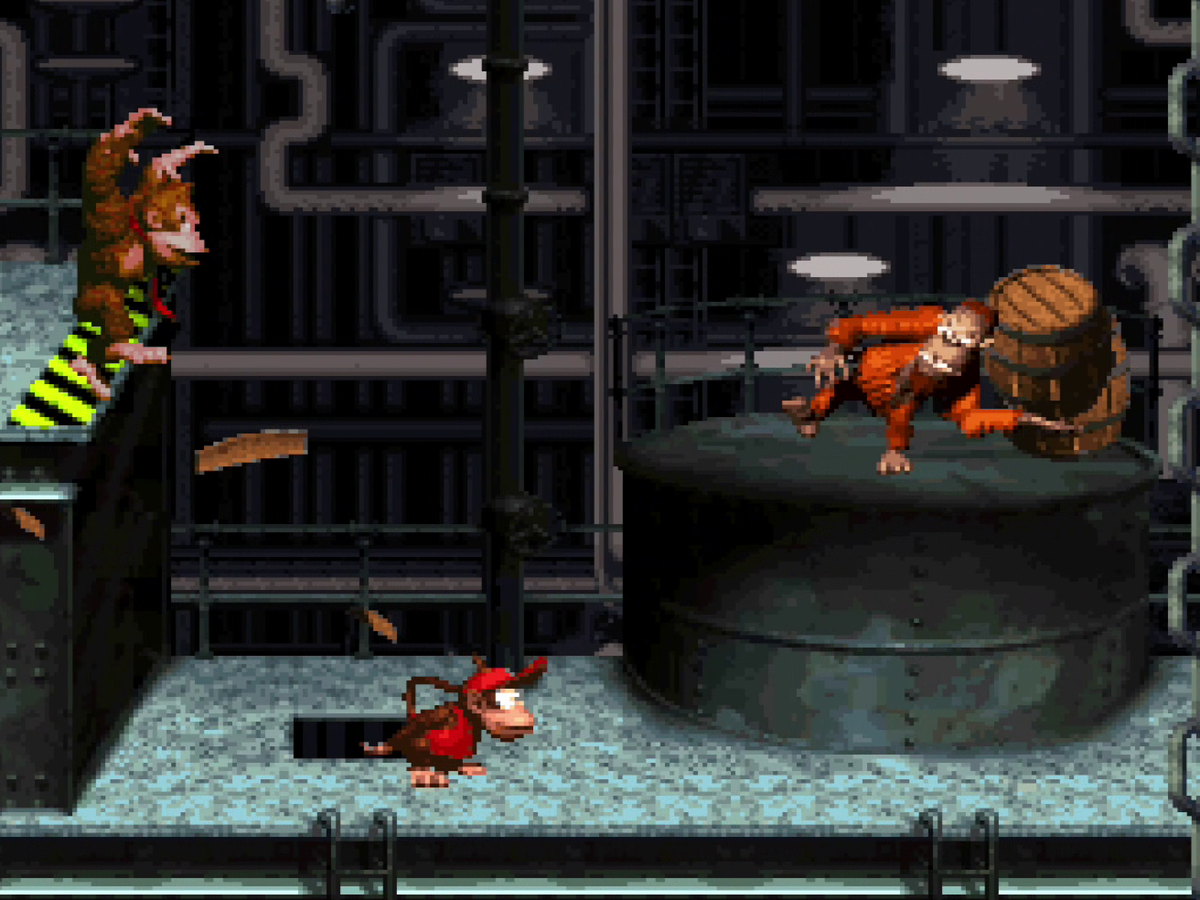
DKC undoubtedly has the player engage with the ideas of fighting against colonialism and capitalism through its mechanics. After all, it does have the player literally fight a giant oil drum, a clear metaphor for pollution and industrial development. Furthermore, this narrative is done entirely through environmental storytelling. The only way a player may pick up on this aspect of DKC is by carefully navigating and paying attention to the environment around them and how it transforms.
As such, I believe that you can craft a convincing case that Donkey Kong Country could be considered an art game. My point in this is to question what exactly an “art game” is. If something that defies the traditional model of an art game, and even predates what is normally considered the state of the art game movement in the mid 2000s, can be considered an art game, then what exactly even is an art game? Is it a term that can meaningfully create a category of games, or is it ultimately a poor term to describe the kind of games it is referring to? Does it create a barrier between high art and low art in games, where only games that are abstract and highly stylized are worthy to be considered an “art” game? Or, is it simply a term meant to encapsulate a movement in the development of games? Ultimately, I’m still not entirely sure.


Very interesting perspective on art games and how colonialism and capitalism, which we usually don’t associate with the more younger-aesthetic side of video games such as the Donkey Kong series, molds into the central plot and game environment and even serves as a critique of corporate malpractices throughout history and even today. I also found it interesting how you compared the more “cartoonish” aspects of the game, such as fighting a giant oil drum or the two forces feuding over some bananas, connects with historical aspects of colonialism like resource exploitation and production monopolies with some real life examples being Big Oil and the Banana Republics.
I think your description of Donkey Kong Country as an art game is a phenomenal example of the issue with the “art game” label. When we hear the word “Artgame,” we tend to have a pre-existing idea in our heads–an idea that, as you have described, actively limits what games we choose to analyze. There was actually a debate on this in my discussion section this week, as we grappled with the struggle of fitting games into a single genera. I think that, while “Artgame” is a helpful descriptor, it should be a modifier rather than an end-all-be-all genera. I think the “art” in “artgames” come from the developer’s intentions, and if the developers intended for Donkey Kong Country to be viewed in the lens you used, it absolutely deserves the title. You make a wonderful argument that subverts the “artgame” genera in a fun and compelling way.
I definitely agree that you can stretch the label of artgame quite far, like you show in your post. However, I do question if Donkey Kong Country fully qualifies fully as an artgame. From what was presented in the blog, DKC seems to moreso show a visualization of capitalism and colonialization, instead of having mechanics centered around engaging with the concepts. I am fully agreed that the artgame label is poorly defined, and so I propose a more narrow definition to maintain the usefulness of the label “artgame” which would also exclude DKC. The unique aspect of games is the systems and mechanics that they contain which allow for user interaction. Thus, any artgame should make use of this aspect and actually explore the themes of its concept through the mechanics and player interaction. This does separate from the usual definition a bit by focusing away from aesthetics and indie development and excludes games like DKC which are only dressed in artgamey concepts and do not engage with them through their mechanics. I do not mean to push down DKC and still think it provides immense value through its visualization of colonialism and capitalism, but instinctively it does not feel like an artgame (as you said) and this definition fits with that.