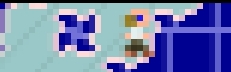
Jason Rohrer’s Passage is a game without an obvious goal; the player can move with the arrow keys, and I embarrassingly tried WASD for a good while before realizing. Notably, at the start, the player cannot move back or move up; this is where your path starts.
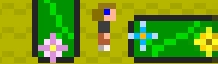
Depending on one’s perspective, the character moves to the right, but as you keep moving, the path forward becomes clear. You don’t move to the right; instead, you move forward while the past becomes a blur. Moving down grants you access to the mazes that are, for some reason, hiding treasures.
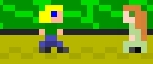
During my first playthrough, I encountered the mysterious woman at the beginning without much thought and assumed gaining her love was a requirement. As I kept exploring, certain paths were inaccessible due to the size of the gaps being too small for both characters to fit through. The inability to explore frustrated me, but I thought about how relationships function and realized what was happening. When in a relationship, one is tied to the person they are with; their decisions are bound to affect their partner. As frustrated as I was, I felt comfort knowing that the pixelated maze world was not completely lonely.
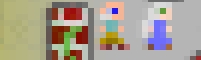
Visually, the characters’ appearances change to represent the passage of time (I actually just realized why this game is called Passage). Moreover, as the path progresses, the world loses a lot of the color that dominated the beginning. Brick walls and a gray floor replace the colorful bushes that once blocked your path. The world gets dimmer at times, but the green eyes of your lover are still reflecting the beauty of the bushes where you met her. Something is lingering in the back of your mind, and you wish it could become a blur, too.

You began this path alone, but finishing it alone was not what you wanted. A gravestone replaces the woman who walked with you, even when the path was frustrating, constraining, and depressing. The green-eyed girl is physically a gravestone, but unlike the many treasures and barriers, she does not become a blur. You forget the layout of the mazes, the floors, the colors, but not your partner. Your body slows down, but time keeps pushing ahead despite your wishes to go back.

The game ends when your character dies. There is a score at the top right, but it means very little after the mini existential crisis you will likely experience.
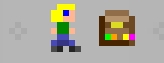
A solo run of this game is possible, though not necessarily encouraged by the game. In fact, even when you walk next to the woman rather than directly in front of her, she still ends up being your wife. Perhaps the distance between you and her is still enough to appreciate her personally. However, if you distance yourself enough from the woman, she will not join you. The world is easier to navigate in the sense that the mazes are easier, but depending on the player, the world can also feel empty and dreadful. To make up for the lack of other characters, treasure chests can grant you blue stars, which increase your score, or flies, which waste your time. A high score is nice if that is your goal, but there is nothing that will prevent the inevitable passage of time on your mind, body, and life.

Passage appears to be a game that is quite limiting, with only two choices to make regarding your relationship status. However, that choice does not necessarily make or break your playthrough; it simply alters the way you approach the world. I gained a sense of joy having the character accompanied by his wife, while I also found the solo exploration exciting. Although the character you control is based on Rohrer, I’d argue that every playthrough feels like a new person’s passage. Every life is different, every goal, every step, every number, and every path. You decide what you want from it and how to navigate it. In that sense, Passage does not have to be depressing or joyful because it is poetic.


I really appreciate the analysis of the pixelation of the game making commentary about how we live our lives in relation to the passage of time. It’s interesting to hear someone else’s perspective on what it meant. Specifically, you point out that the past becomes a blur, which wasn’t what I initially noticed. From the beginning of the game, what stuck out to me was the unclarity of the forward path (with obvious commentary about how we never really now our paths forward). But as you point out, behind the characters also becomes blurry, which makes it clear to me the game is pushing this “you can only control the present” narrative. I also became frustrated with not being able to explore certain areas because both players couldn’t fit, but I never thought to try to play the game solo because I thought that meeting the parter was some requirement of the game.
I like your emphasis on the various choices presented to the player. The main takeaway I had from the game was that you have the choice on how to spend your life. The score is completely arbitrary, so you can choose to dedicate time to increasing it or not. At first, I thought the maze was just if you were curious enough to explore, and I got enough out of that myself without ever knowing about the treasure chests. It took a few more playthroughs for me to discover them.
To build off of your point that your relationship status simply alters the way in which a player may approach the world, interestingly, there are only two real constants in the game — that of your character and that of the progression of time. Whether you choose to be joined by a partner, solo run the map, or even just stand still the entire time, at the end of five minutes, your character will die. The reason why our choices of our relationship status, for example, matter in passage is because we are aware of the fact that we have a set amount of time to do what we want. There are a million different paths we can take in life (or a couple, in the case of passage). But, ultimately being fated to die gives your choices meaning because they are the choices you decide to assign value to. Passage is a simple, timeless memento mori game that reminds us to live life to the fullest.
I personally feel as though there is no such thing as a “right path” in Passage because the game is ultimately what you make of it. In my first playthrough of the game I walked forward the entire time not knowing you could even travel off the obvious side scrolling path and, to me at least, this playthrough, as well as any other playthrough is perfectly valid in its own way and will always end with the progression of time taking the life of the player character. In the case of Passage i would consider it to have deceptive exploration because unlike in games like Super Metroid where exploration is also encouraged for the sake of being able to traverse more easily by finding hidden movement options like the spider ball or additional weapons, in passage all the chests do is fuel a mysterious number at the top of the window. Just like Super Metroid though, as long as you hit specific beats of progression and don’t stop playing you will eventually win and the endings for both of these games will not change (unless you count samus changing her appearance as a different ending). This is to say you can explore all you want in passage but it isn’t the “right” or “wrong” thing to do, its just something you *can* do.
I love those last sentences about choice! Passage, in all of its visual simplicity, is quite philosophically complex in that it never explicitly lay out its goals: sure there is a person to fall in love with, a score counter to raise, and treasure boxes to collect, but you are never truly told that you have won/lost. Instead, the game seems to encourage open exploration and choice-making with the looming knowledge that you will eventually die, but that you can always start again. The first time I played it, I didn’t realize that you could go up and down, so I spent 5 minutes walking with my partner while watching pretty graphics pass me by, which felt very sweet/ romantic. The next few times, I explored the world (which filled me with excitement and wonder) and collected treasure boxes (which confused me more than anything. What is this “treasure” and where does it go? Can I do something with it?) All this to say, Passage provides the player with an opportunity for self reflection/ evaluation of what they value, whether that love, discovery, capital, etc. Not bad for a bunch of pixels!
I agree with your closing remarks about choices in Passage not having a binary moral quality (good or bad) to them. I think, while certain stylistic aspects of the game — the wide horizontal screen that encourages rightward movement, treasure chests that release stars — are reminiscent of games that privilege certain decisions as “better” or more optimal to “winning,” Passage subverts this expectation by concluding with the death of the character(s) regardless of a player’s chosen path. Moreover, the fact that any points earned through uncovering chests don’t offer any tangible reward (e.g. powerups, skill boosting, life extension), is indicative of Rohrer’s neutral stance; each choice a player makes is only valuable or important insofar as it is what they want to do. For that reason, the treasures that are closed off when a player chooses to travel with the wife are not so much lost opportunities as they are the constraints that naturally come with romantic commitments. Overall, I really enjoyed reading through your post, as your narration of your initial playthroughs and resulting reflection mirrored a lot of the thought processes I had during and after playing. Passage’s lack of a clear objective is what makes the game all the more powerful and introspective for the player!
What you said about each playthrough being a completely new life has given me a new perspective. Initially, I felt as though replaying was changing decisions, but now I can interpret it as living a new, separate life. Not everyone finds love, so seeing many interpret the companion route as the “correct” one seemed a bit demoralizing for those who may journey alone. Not having a life companion doesn’t necessarily mean that your life does not have value, and as the game suggests, you sacrifice opportunities when you choose to have a life partner. One choice isn’t inherently better because players will have different values to judge success by.
Your reflection captures the existential melancholy of Passage beautifully, and I love how you frame each playthrough as a distinct life. What struck me while reading is how this multiplicity of lives aligns with Miguel Sicart’s idea of play as appropriation. Every player reclaims Rohrer’s rules to express their own values. In that sense, Passage feels less like a fixed system of meaning and more like what Huizinga might call a “possibility space” where the act of play itself becomes the narrative.